How To Become an Independent Medical Courier

Jump to section
Welcome to the pathway of an exciting career - the world of medical couriers. As experts in the field, we're here to guide you on how to become a medical courier.
Why Medical Couriers Are Thriving: A Growing Field
In the last years, we saw a huge boom in medical courier services. Since the pandemic, demand for medical couriers has surged over 27%, making it one of the quickest-growing professions globally. The global medical courier market was valued at $6.8 billion in 2024 and is projected to surpass $9 billion by 2029, growing at an annual rate of about 6%.
More hospitals and clinics want reliable and licensed couriers to deliver their test kits, specimens, organs, or prescriptions to the end locations.
Looking for Medical Courier Work?
Job board dedicated to medical courier work. We monitor companies daily and update 400+ real openings and contracts across the U.S. - all in one place.
According to the Bureau of Labor Statistics, couriers and express delivery services (which include medical couriers) now employ more than 1 million workers in the U.S. The BLS projects this sector to grow faster than the overall economy through 2034, because of the rising demand for healthcare delivery and same-day medical transport.
Types of Medical Courier Deliveries
Before you begin, it helps to understand what types of medical deliveries you may handle as a medical courier independent contractor. Each type has different requirements, pay rates, and certifications needed. Specializing in one or two areas can help you stand out when approaching companies for contracts.
Blood draws, urine samples, tissue biopsies, and other lab specimens make up the bulk of medical courier work. These are time-sensitive, and most need to be delivered within 2-4 hours of the pickup. You'll pick up from clinics, doctors' offices, and hospitals and deliver to reference laboratories like Quest Diagnostics or LabCorp.
Pharmacies use medical couriers for daily prescription delivery routes - delivering medications to patient homes, assisted living centers, and long-term care facilities. Some medications require refrigerated transport (cold-chain handling), which means you'll need insulated coolers and temperature monitoring.
Durable medical equipment companies need couriers to deliver hospital beds, wheelchairs, oxygen concentrators and other medical equipment to patient homes. This work often requires a cargo van or box truck and sometimes a 2-person team for heavy items.
While a good portion of healthcare has gone digital, physical medical records, X-ray films, and consent forms are still moved between facilities daily. These require strict HIPAA chain-of-custody handling.
Blood banks and organ procurement organizations hire medical couriers for the most time-critical deliveries in healthcare. These jobs pay the highest rates but require specialized training and equipment.
Hospitals and surgery centers need surgical kits, sterile instruments, and implants moved between facilities - often on tight timelines around scheduled procedures.
Medical Courier Independent Contractor: What It Takes
Most people getting into this field will work as a medical courier independent contractor, not as an employee. That means you're running your own medical courier business, even if it's just you and your car. You set your own schedule, pick your own clients, and file taxes as a 1099 contractor.
Starting a medical courier business as an independent contractor is different from getting hired as an employee. As an employee, the company handles your insurance, provides equipment, and assigns your routes. As an independent contractor, all of that is on you. But the tradeoff is more control and higher earning potential.
Here's what you specifically need to become a medical courier independent contractor:
LLC or business license: You need a registered business entity. Most independent couriers start with an LLC because it protects your personal assets. You'll also need an EIN from the IRS. See our guide on how to start a business.
Commercial auto insurance in your company's name: Personal auto insurance won't cover you. Most facilities require $1M CSL minimum before they'll sign a contract with you.
Your own equipment: Coolers, specimen bags, spill kit, temperature monitors. Some companies provide these for employees, but as a contractor, you're expected to have your own.
Multiple client relationships: Unlike an employee who works for one company, an independent contractor can work with as many clients as they want. This is how you stack routes and build real income.
Invoicing and bookkeeping: You're responsible for sending invoices, tracking expenses, and handling your own quarterly taxes. Keep your business finances separate from personal.
If you're looking for 1099 medical courier jobs near you, start by applying to courier companies as a contractor. Medical supply delivery independent contractor positions are posted regularly on job boards, but the best contracts usually come through direct outreach to labs, pharmacies, and hospitals in your area.
What You Need to Start a Medical Courier Service: Basic Requirements
If you think of starting a career as an independent medical courier, you'll need to meet some basic requirements, including proper medical courier training to handle sensitive materials and comply with regulations:
| Requirement | Details |
|---|---|
| Driver's License | Valid license with a clean driving record |
| Age | Must be 21 or older (most companies) |
| Local Knowledge | Familiarity with your work city is essential |
| Vehicle | Registered and inspected vehicle under 10 years old |
| Certifications | HIPAA certificate + Bloodborne Pathogen training |
| Screening | Background checks and drug screenings may be required |
| Business License / LLC | Required for independent contracting - at least open a business license or LLC (create your EIN) for flexibility to work with multiple companies simultaneously |
Medical Courier Vehicle and Equipment Requirements
Your vehicle is your office. Most medical courier companies require a reliable vehicle that's less than 10 years old, registered, and insured. But beyond the vehicle itself, here's what you'll need depending on what type of deliveries you handle:
Vehicle Types by Delivery Type
| Vehicle | Best For | Notes |
|---|---|---|
| Sedan / SUV | Lab specimens, documents, small pharma deliveries | Most couriers start here - no special vehicle needed |
| Cargo Van | Larger Rx routes, DME, high-volume work | Opens more contract opportunities. See cargo van delivery |
| Box Truck + Lift Gate | Hospital beds, heavy DME, freight logistics | Required for large medical equipment |
Necessary Equipment
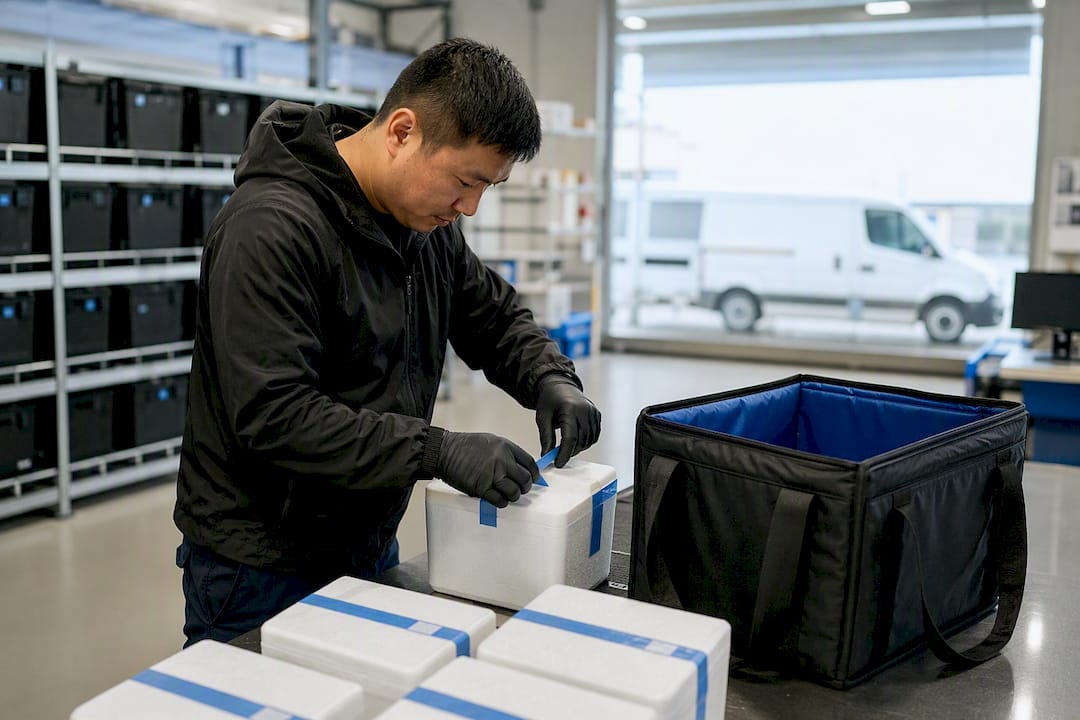
Insulated coolers and cold packs: For specimens, vaccines, and refrigerated medications. Some companies provide these; others expect you to have your own.
Temperature monitoring devices: Digital thermometers or data loggers that document temperature throughout transit. Required for pharmaceutical and specimen deliveries.
Specimen transport bags: Leak-proof, biohazard-labeled bags. Required for blood and specimen transport.
Biohazard spill kit: Absorbent pads, disinfectant, gloves, and disposal bags. OSHA requires this if you're handling potentially infectious materials.
PPE (Personal Protective Equipment): Gloves and face protection. Required when handling specimens or biohazardous materials.
GPS and smartphone: For real-time tracking, route optimization, and proof-of-delivery photos.
Medical Courier Startup Costs
Here's a realistic breakdown of what it costs to start as an independent medical courier:
| Item | Estimated Cost |
|---|---|
| HIPAA Certification | $10 - $50 |
| Bloodborne Pathogen Training | $10 - $50 |
| Business License / LLC Filing | $50 - $200 |
| Commercial Auto Insurance (monthly) | $150 - $600/mo |
| Coolers, Specimen Bags, Spill Kit | $100 - $200 |
| Total First-Month Investment | ~$400 - $1,000 |
* Assumes you already have a suitable vehicle
Skills That Stand Out: Setting Yourself Apart
Besides meeting the basics, having specific skills can make you a better candidate:
Stay organized, have all your documents up to date. Most deliveries are on the clock - being late repeatedly will reduce your work and eventually end the relationship.
Basic customer service skills for positive interactions with clinic staff, nurses, and pharmacy teams.
Flexibility to drive different hours. Companies like to know they can call and ask for help if needed, and your answer will be yes.
Benefits of Being a Medical Courier: What's in It for You
Choose your own working hours and schedule.
Work for yourself as an independent contractor.
Pick the clients or companies you want to contract with.
Play a direct role in patient care - getting specimens to labs on time and medications to patients who need them.
Medical Courier Salary: What You Can Really Earn
Medical couriers, on average, earn between $35,000 and $50,000 annually, but being an independent contractor, you have no limit. There can be routed work that requires 2-4 hours of your time, and you can combine it with your regular medical deliveries, and your annual earnings can surpass $100,000. That's why it is so important to build relationships with multiple local companies, which will help you get the volume that you need and the chance to combine your work so you can increase your earnings.
Employee vs. Independent Contractor Pay
- $15-$30/hour
- Some offer health insurance
- PTO and vehicle allowances
- Company handles expenses
- $25-$60/hour equivalent
- $50-$500 per route
- Cover own expenses
- Net income: $50K-$110K
Highest-Paying Medical Courier Work
Not all medical courier work pays the same:
| Delivery Type | Pay Range | Pay Per |
|---|---|---|
| Organ & Tissue Transport | $100 - $500+ | per delivery |
| Medical Equipment (DME) | $100 - $400+ | per delivery |
| Specimen Pickup Routes | $50 - $250+ | per route |
| STAT / On-Call Deliveries | $30 - $100+ | per delivery |
| Pharmacy Deliveries | $15 - $30+ | per delivery |
*Pay rates and salaries vary by region, experience, and contract type. Figures shown are industry estimates and not guaranteed earnings.
Understanding the Role: Delivering Health, One Mile at a Time
Most medical couriers work as independent contractors, delivering medications, supplies, specimens, test results, etc. You will work with confidential medical records that often are part of the deliveries and demand to keep them secure and safe.
Becoming a Certified Medical Courier: How to Get Certification Online
To start as a certified medical courier, you must get your HIPAA and Bloodborne Pathogens certificates in 99% of cases. The medical courier certification cost usually ranges from $10 to $50 per certificate, and these certifications are typically valid for 1 to 2 years. We suggest using the websites below, as they are some of the best and fastest places to obtain your HIPAA and Bloodborne training online. This training will give you the skills you need to secure a top medical courier job.
Medical courier companies may also require getting your OSHA certificate, but that's not always the case, so you should ask first if you need it. Here are the links to the certifications you need to start your medical courier business:
Stand out to medical courier companies by earning essential safety and compliance certificates.
HIPAA Certification for Medical CourierBloodborne Pathogens
Protect Yourself - Earn Your CertificateOSHA Certificate
Stay Safe at Work - Get Certified
HIPAA and OSHA Compliance: What It Means on the Road
Getting certified is step one, but understanding what HIPAA and OSHA mean in your day-to-day work as a medical courier is what keeps you compliant - and keeps your contracts.
Want to move faster?
Get instant access to beginner training, courier jobs in any state, and weekly updates. Learn how to get certified, set up your LLC, and start landing courier work.
Be ready for questions like:
Handling Damaged Packages: Show and explain how you'd handle this situation and what you would do.
Physical Capabilities: Confirm your ability to fit the job's physical demands; sometimes, you must lift totes with liquid or heavy items.
Dealing with Delays: Showcase your problem-solving skills and prioritize multiple orders that can be late.
Managing Unprepared Pick-Ups: Demonstrate your preparedness for unexpected situations.
Applying for a Medical Courier Job: A Step-by-Step Guide
Understand the company's reputation, pay, benefits, and service areas.
Prepare your documents and apply online on the company's website; most have a form to fill out.
Confirm your application was received and ask for the next steps if needed.
Gather physical copies of your documents for the interview.
Maintain professionalism and certifications after being hired.
How to Get Medical Courier Contracts
Getting hired as an employee is one path, but the real earning potential comes from landing your own medical courier contracts as an independent contractor. Contracts guarantee recurring revenue - a set number of routes per day or week - instead of waiting for one-off calls.
The most common contracts come from reference laboratories (Quest, LabCorp, local labs), retail pharmacies, DME companies, hospitals, and blood banks. Many of these contracts aren't advertised - they go to couriers who show up prepared with their certifications, insurance, and a professional pitch.
Here's a quick overview of where to find medical courier contracts near you:
| Source | How It Works |
|---|---|
| Job Boards | Indeed, ZipRecruiter, and CouriGigs regularly post medical courier contractor positions. |
| Direct Outreach | Call or visit local labs, pharmacies, and hospitals. Ask to speak with their logistics or courier manager. |
| Other Courier Companies | Subcontracting under an established company is the fastest way to start. |
| Government RFPs | State and county governments post Requests for Proposals for medical transportation services. |
| Industry Associations | The Customized Logistics and Delivery Association (CLDA) provides networking and contract leads. |
We wrote a complete guide on this topic: How to Get Medical Courier Contracts - Step-by-Step Guide. It covers every type of company that hires couriers, exactly where to find contracts, how to pitch, and how to win your first contract even with no experience.
Congratulations on choosing a career as a medical courier. Whether you opt for an independent contractor or join a courier company as an employee, uphold professionalism and commitment as you enter this rewarding career. Your journey as a medical courier awaits - embrace the road to success!
Frequently Asked Questions About Becoming a Medical Courier
Related articles
Pharmacy Delivery Chain of Custody: A Practical Playbook
Under DEA rules, choosing your courier is part of your compliance position, not just procurement. What a custody record must contain, where

How to Organize an Outpatient Lab Courier Schedule
Build it backwards from your lab's cutoff and your specimens' stability windows. Six steps for clinic managers, including what to put in the
Medical Courier Requirements in Washington: Full Checklist
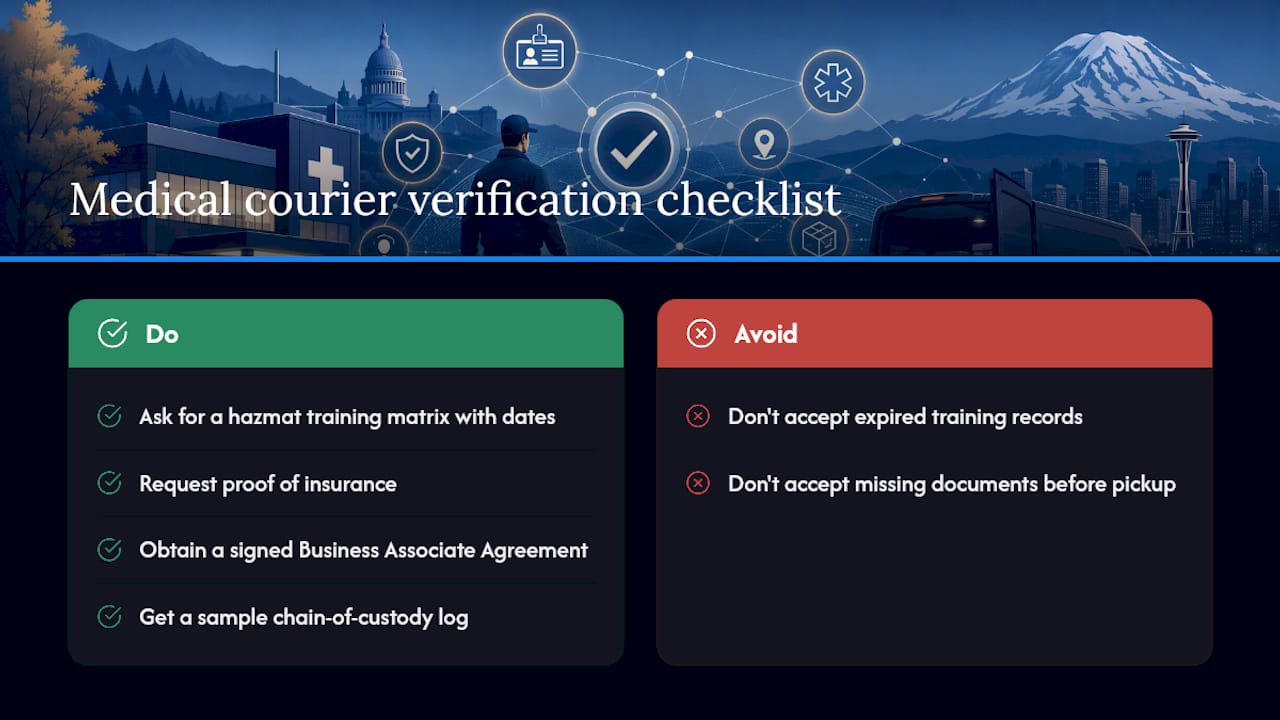
What the specimen requires and what the courier must produce, in one place: UN3373 packaging measurements, OSHA training and Exposure Contro