How to Ship Oversized Freight in Washington State

Jump to section
Freight is oversized in Washington once it passes 8 feet 6 inches wide, 14 feet tall, or 40 feet long on a single unit. Past any of those, you need a permit from WSDOT before the load moves, and the permit is only issued for loads that cannot be broken down into smaller pieces. Get the measurements and the permit right and a local oversized move is routine. Get them wrong and the load sits.
What counts as oversized in Washington
These are the state legal limits. Stay inside all of them and you need no permit at all.
- Width: 8 feet 6 inches
- Height: 14 feet
- Length: 40 feet for a single unit, 53 feet for a tractor and trailer
- Weight: depends on your axle count and spacing, not on one flat number
Cross any single limit and the whole load is treated as oversized. A pallet stack that is legal in every other dimension but stands 14 feet 4 inches tall still needs a permit.
One rule catches people out: permits are issued only for non-divisible loads. If your shipment can be split into two legal loads, the state expects you to split it. A transformer or a piece of machinery qualifies. Forty pallets of product do not.
Which permit you need, and what it costs
WSDOT issues these through Commercial Vehicle Services. For most local moves you want one of the first two.
- Single trip oversize or overweight permit. Route specific, valid 3 days. Dimensional permits cost $10. Weight permits start at $14.
- Continuous or annual permits if you move loads regularly. A non-divisible dimensional permit covering up to 14 feet wide and 15 feet high runs $10 to $20 per month. A single trailer permit for divisible loads up to 56 feet is $10 a month or $100 a year.
- Manufactured housing up to 15 feet wide or high is $30 a month or $360 a year.
Those numbers are small. The cost of an oversized move is almost never the permit, it is the delay when the paperwork is wrong.
Superloads need weeks, not days
Washington treats a load as a superload once it exceeds 16 feet wide, 16 feet high, 125 feet of load length, or 200,000 pounds. The lead times jump:
- Over 16 feet wide or high: written application at least 7 calendar days before the move.
- Over 200,000 pounds: written application at least 30 days before the move.
If your load is anywhere near those thresholds, start the conversation a month out. Bridge and structure reviews take time, and there is no way to buy your way to the front of that queue.

Choosing the vehicle
The vehicle decision is where local oversized moves are won or lost, because the wrong truck creates access problems and can void a permit if the specs do not match what you filed.
Box trucks, 16 to 26 feet. These carry roughly 4,000 to 12,000 pounds and handle most single large items. They work in tight urban access points and do not need a loading dock when the driver has a liftgate. For short haul freight inside the Seattle metro this is usually the right call.
Flatbeds. Once the load will not fit inside a box, or needs crane or forklift loading from the side, a flatbed is the answer. Open decks also handle height better, since you are not adding the box roof to your load height.
Step decks and lowboys. For tall equipment, dropping the deck height is what keeps you under 14 feet and out of permit territory entirely. It is worth pricing this before assuming you need a permit.
Step by step for a local oversized move
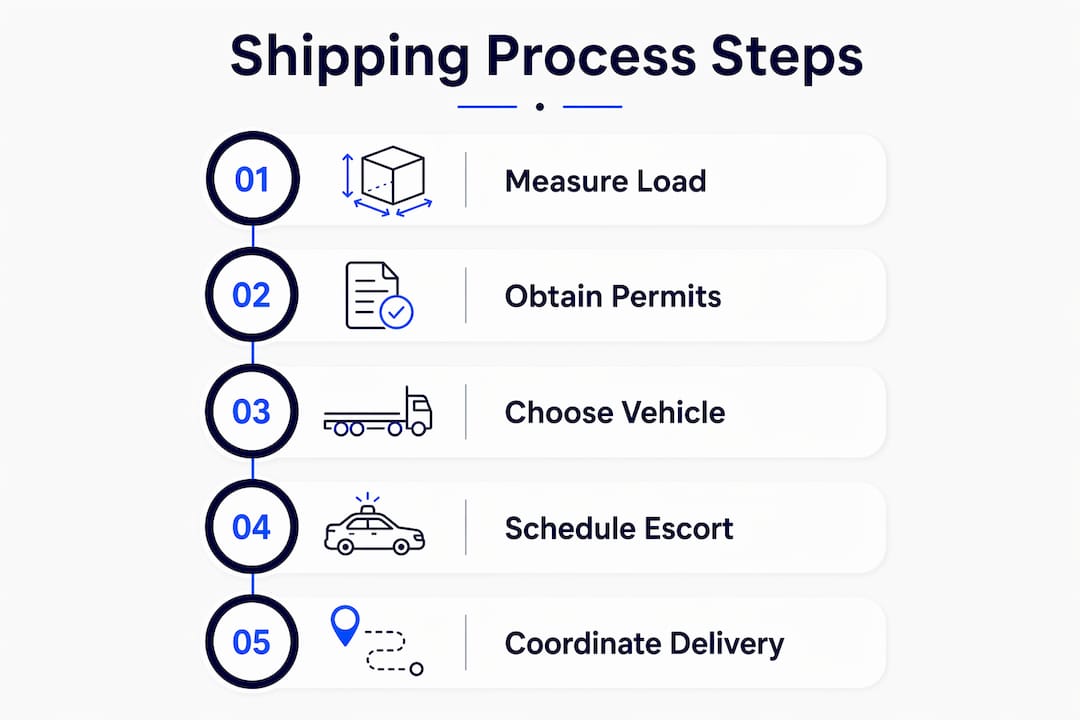
1. Measure the load yourself. Width, height, length and weight, including the trailer deck height under it. Height is the dimension people estimate and then get wrong.
2. Check whether you are actually oversized. Sometimes a different trailer keeps you legal, and legal is faster and cheaper than permitted.
3. Apply for the permit against your real route. Single trip permits are route specific. Changing the route after the fact usually means applying again.
4. Confirm escorts and restrictions. Wider and longer loads require pilot or escort vehicles, and permitted loads can be restricted from state highways on holidays. Confirm both with Commercial Vehicle Services at CVSpermits@wsdot.wa.gov or 360-704-6340 before you book anything.
5. Coordinate both ends before the truck rolls. Who is unloading, with what equipment, and is there room to turn. A load that arrives to a site with no forklift has not been delivered.
Where local oversized moves usually go wrong
- Estimated dimensions. The permit is written against what you filed. If the load is taller than you said, the permit does not cover it.
- Forgetting the deck. Load height is measured from the road, not from the trailer floor.
- Applying too late. Routine permits are quick. Anything touching superload territory is not.
- Assuming the route is fine. Low bridges, weight restricted structures and construction detours all change what is legal.
- No plan at the destination. Access and unloading equipment cause more failed deliveries than permits do.
How AMCO handles local oversized freight
We run local freight across the Puget Sound with 16 and 26 foot box trucks, and we quote it on real driving miles between your pickup and delivery ZIP codes rather than straight line distance. Every quote shows the mileage and estimated travel time, so you can see what you are paying for.
What we ask for up front is the same list above: measured dimensions, weight, whether there is a dock at each end, and what equipment is available to unload. That is the information that decides whether your load is a routine run or a permitted move, and getting it at quote time is what keeps the invoice equal to the quote.
If the load turns out to be legal after all, we say so. Smaller items that fit a cargo van are cheaper to move that way, and recurring freight is worth pricing as a scheduled route instead of one off jobs.
For loads that genuinely need heavy haul specialists, national brokers such as Worldwide Express and McClain carry the equipment and the permitting desks for it. We would rather point you there than take a load we should not.
Not sure if your load needs a permit?
Send the measured dimensions, weight and both ZIP codes. We will tell you whether it is legal, and quote it either way.
Frequently asked questions
What counts as oversized freight in Washington State?
Anything over 8 feet 6 inches wide, 14 feet tall, or 40 feet long on a single unit, or over the weight your axle configuration allows. Exceeding one of those is enough. Permits are issued only for loads that cannot be divided into smaller legal shipments.
How far in advance do I need to apply for an oversized permit?
Routine single trip permits can be arranged quickly and are valid for 3 days. Loads over 16 feet wide or high need a written application at least 7 calendar days out, and anything over 200,000 pounds needs 30 days.
Do I need an escort vehicle?
Wider and longer loads do. The thresholds depend on the dimension and the route, so confirm with WSDOT Commercial Vehicle Services at 360-704-6340 rather than guessing. Booking a pilot car late is a common reason a move slips a day.
How much does an oversize permit cost in Washington?
A dimensional single trip permit is $10 and weight permits start at $14. Continuous permits for regular movers run from $10 to $20 a month depending on type. Permit cost is rarely the expensive part of an oversized move.
Why use a local carrier instead of a national network?
For moves inside the Puget Sound, a local carrier knows the bridges, the access constraints and the routes, and you get one dispatcher rather than a handoff between terminals. For long haul heavy equipment, a national heavy haul specialist is the better tool.
What delays oversized shipments most often?
Wrong measurements. The permit is written against the numbers you provide, so a load that is four inches taller than filed is not covered, and the driver cannot legally proceed. Measure, do not estimate.
Sources
- Commercial vehicle permits, Washington State Department of Transportation.
- Permit types and fees, WSDOT.
- Superloads, WSDOT.
- Worldwide Express, national freight and logistics.
- McClain, heavy haul and specialized transport.
- McCabe Logistics.
- Gold Nova Logistics.
- Davis Delivery.
Related articles

Electronic Proof of Delivery: What It Is and Why It Matters
A timestamp, a location, a name and a photo, captured the moment the driver walks away. What belongs in an ePOD record, whether a screen sig

The Role of a Courier in Supply Chain Operations
Couriers move what parcel and freight networks cannot: the same day lane, the regulated delivery, the part that stops a line. Here is where

What Is a Delivery Quote? How to Get an Accurate One
A delivery quote is a carrier's cost estimate, not a final invoice. Here is what it includes, why weight and dimensions decide its accuracy,