What Is a Delivery Quote? How to Get an Accurate One

Jump to section
A delivery quote is a carrier's estimate of what a shipment will cost and on what terms. It is not an invoice. The price holds only while the details you gave stay true and the quote is still inside its validity window. Change the weight, the packaging, or the address type, and the number changes with it.
Three things are worth knowing before you request one:
- A quote is an estimate, not a locked price, unless the carrier explicitly issues it as binding.
- Quotes expire. Spot rates often last a few days. Contract pricing lasts longer.
- Weight and dimensions drive accuracy more than anything else. Get those wrong and the quote is a guess.
As a shipping quote explainer from Simple Forwarding puts it, an accurate quote prevents surprise fees and delays, and it lets you plan landed cost before anything moves.
What a delivery quote includes
A real quote is a structured document, not one dollar figure. A missing field usually means a surcharge shows up later on the invoice. The UNIS Freight and Logistics Glossary lists base freight, surcharges, insurance options and terms as the standard parts of a freight quotation.
Expect to see all of this:
- Origin and destination. Full addresses with ZIP codes, not just city names.
- What you are shipping. Commodity type, and for cross border moves the HS code.
- Weight and dimensions. Actual weight per piece, plus length, width and height.
- Piece count and packaging. Loose cartons, pallets and crates price differently.
- Service level. Same day, scheduled, expedited, and the transit time that goes with it.
- Base charge. The core rate before anything is added.
- Surcharges. Fuel, residential delivery, liftgate, inside delivery, reweigh, address correction.
- Insurance or liability limit. Declared value coverage, or the carrier's default limit.
- Who pays. Billing party, and for international freight the Incoterm.
- Expiry date. After this, the rate is no longer held.
Packaging type is the field that causes the most invoice disputes. Switching from floor loaded boxes to pallets after the quote was issued changes the price, because the carrier prices the two differently. Say how it will be packaged in the request.
The three types of quote
Estimate, non binding. The common one. A carrier prices what you described. If reality differs at pickup, the carrier can adjust. Most spot parcel and LTL quotes work this way.
Binding quote. A written commitment to a price for a defined shipment inside a set window. It holds on three conditions: your data was accurate, both sides confirmed it, and the shipment moves before the quote expires. Miss one and the carrier can fall back to standard rates.
Pro forma quote. A documentation tool for customs, used so authorities can assess duties and taxes. It does not commit a carrier to move anything at that price. A customs clearance specialist handles these on international moves.
How carriers calculate the number

Almost every quote is a base rate plus variables. The sequence looks like this.
Billable weight first. Carriers compare actual weight against dimensional weight and bill whichever is higher. For domestic US parcel the formula is length times width times height in inches, divided by 139. A box at 24 by 18 by 12 inches gives 5,184 divided by 139, so 37.3 pounds. If that box actually weighs 20 pounds, you are billed at 37.3.
Then distance or zone. Parcel carriers use zones based on origin and destination ZIP. Courier and freight operators price by real driving miles on the lane.
Then service level. Same day costs more than scheduled, because it takes a vehicle off a planned route.
Then accessorials. Residential address, liftgate, inside delivery, waiting time, second attempt. Speed Commerce notes these add ons are where quoted and invoiced totals usually part ways.
Movargo's freight quote guide goes deeper on reading the fine print, and it is worth ten minutes if you ship freight regularly.
How to get an accurate quote on the first try
Most bad quotes trace back to missing information, not to a carrier being difficult. Send this and you will usually get a number you can trust:
- Pickup and delivery ZIP codes, and whether each address is commercial or residential.
- Weight per piece, measured, not estimated from memory.
- Dimensions of the largest piece, and how many pieces there are.
- Packaging: loose boxes, pallets, crates, totes.
- The date and time window you need, and whether that is firm or flexible.
- Anything that needs equipment: no loading dock, stairs, a heavy single piece.
- Anything that needs paperwork: chain of custody, signature, photo proof, BOL.
If a carrier gives you a price without asking for weight and dimensions, treat that number as a rough guide only.
How AMCO builds a quote
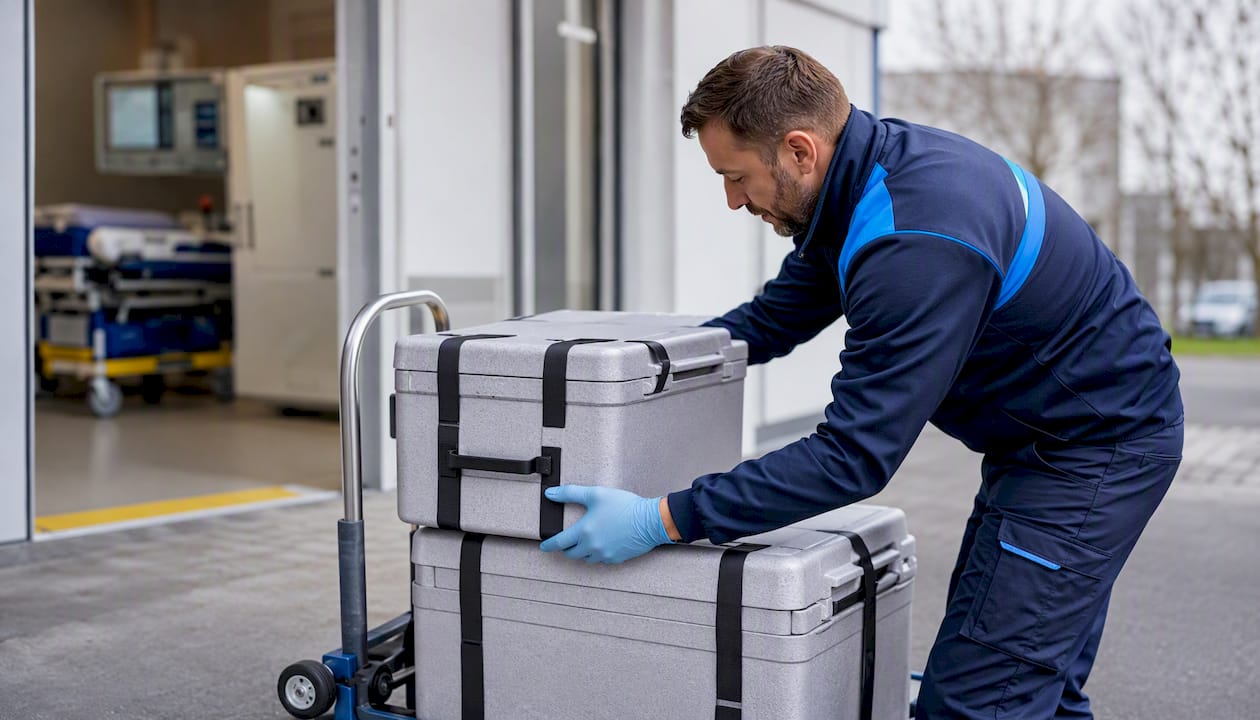
Our quotes are line item and they follow the same structure every time, so you can compare them against each other and against anyone else.
Distance is measured, not guessed. When a quote request comes in, we calculate real driving miles between the pickup and delivery ZIP codes rather than straight line distance. A 10 mile straight line across Puget Sound is not a 10 mile drive.
The vehicle sets the base. A car or minivan, a cargo van, a 16 foot box truck and a 26 foot box truck each carry their own base rate and their own rate per mile. Telling us the real size and weight up front is what keeps the quote and the invoice the same number.
Scheduled costs less than same day. A run we can plan into a route prices below one that pulls a driver off their day. If your delivery can wait until tomorrow morning, say so, because it is usually cheaper.
Every quote shows the miles and the estimated travel time, so you can see what you are paying for instead of a single unexplained figure.
For recurring work the math moves in your favor. A scheduled route prices per stop, and dense routes price lowest per door. That is how our food brand routes and medical courier customers end up paying less per delivery than they would ordering one at a time. Larger palletized moves are quoted as freight instead, on weight and equipment rather than per stop.
We answer online quote requests within about 30 minutes during business hours. If you need an answer faster, call dispatch on (425) 400-3919.
Need a real number for a real shipment?
Send the pickup and delivery ZIPs, the weight and the date. You get back a line item quote with the miles shown.
Frequently asked questions
Is a delivery quote legally binding?
Only if the carrier issued it as a binding quote and your shipment matches what you described. A standard estimate is not binding, and the carrier can re-rate it if the weight, dimensions, packaging or address type turn out different.
How long is a delivery quote valid?
Spot quotes commonly hold for 24 to 72 hours, because fuel and capacity move. Contract rates hold for the term of the agreement. The expiry date should be printed on the quote. If it is not, ask for it.
Why was my invoice higher than my quote?
Usually one of four things: the freight was reweighed and came in heavier, dimensional weight applied, the delivery address turned out to be residential, or the location needed a liftgate. Ask for the reweigh certificate or the accessorial line and it becomes clear quickly.
What is dimensional weight?
A pricing method for bulky items that weigh little. The carrier calculates length times width times height in inches divided by 139, then bills whichever is higher, that or the actual weight. It is why a large box of packing material can cost more to ship than a small box of tools.
Do I need exact dimensions for a courier quote?
For a small parcel inside the Seattle metro, a close estimate is usually enough. For anything palletized, oversized or going on a box truck, measure it. That is the difference between a quote you can budget against and one that changes at pickup.
Can I get one price for repeat deliveries?
Yes. Recurring work is quoted as a route with a per stop rate rather than as separate one off jobs, and it is normally cheaper per delivery. Send the stop list and the days you need it, and we build the rate card around it.
Sources
- UNECE QUOTES EDI specification, the international standard defining the electronic Quote message.
- Harmonized System (HS) codes, US International Trade Administration.
- What Is a Shipping Quote? A Complete Explainer, Simple Forwarding.
- How to Read a Freight Quote: What Is Hidden in the Fine Print, Movargo.
- Freight Shipping Quotes Explained, Speed Commerce.
- Freight Quotation, UNIS Freight and Logistics Glossary.
- Customs clearance services, USI.
Related articles

Electronic Proof of Delivery: What It Is and Why It Matters
A timestamp, a location, a name and a photo, captured the moment the driver walks away. What belongs in an ePOD record, whether a screen sig

The Role of a Courier in Supply Chain Operations
Couriers move what parcel and freight networks cannot: the same day lane, the regulated delivery, the part that stops a line. Here is where

How to Ship Oversized Freight in Washington State
Freight is oversized in Washington past 8 feet 6 inches wide, 14 feet tall or 40 feet long. Here are the real permit limits, costs, lead tim