STAT vs Routine Lab Courier: What Healthcare Teams Should Know
Jump to section
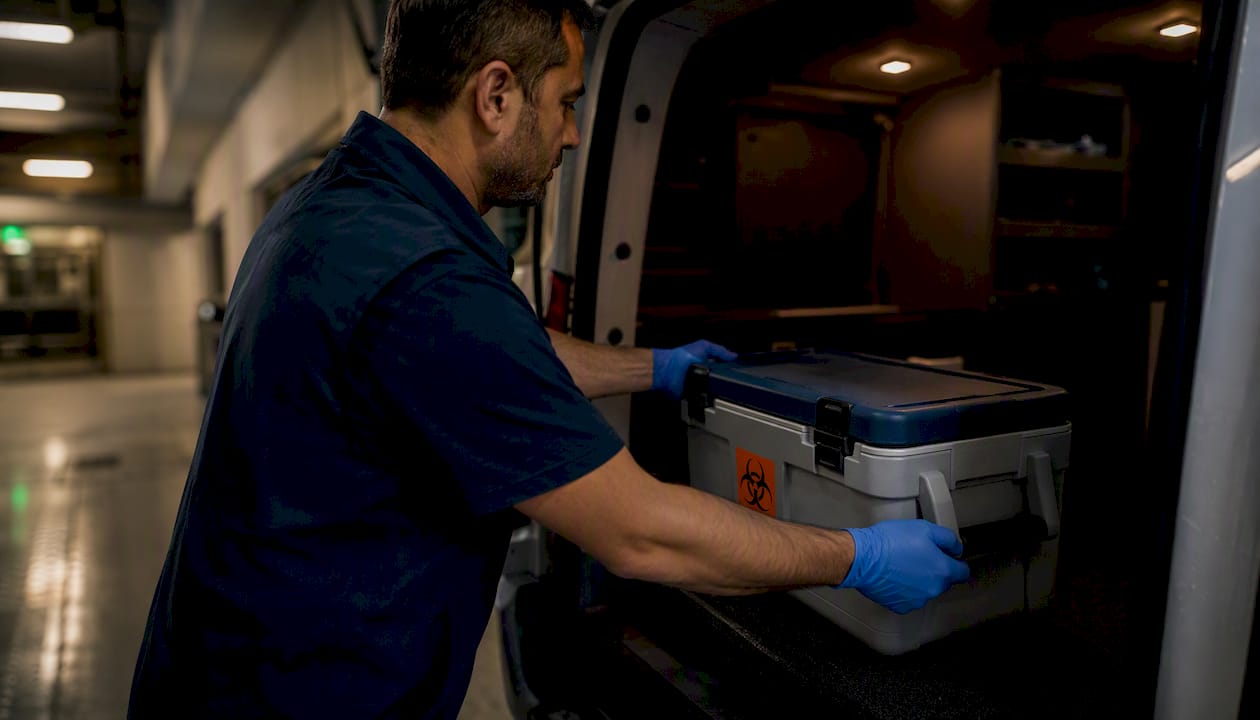
A STAT lab courier run is dispatched immediately and goes straight to the lab. A routine run rides a scheduled route with other stops. The difference is not urgency in the abstract, it is whether a result changes what a clinician does in the next hour. Order STAT for that. Order routine for everything else, because routine costs less and, on a well built route, still gets there today.
What the two words actually mean
STAT means the specimen leaves now, by itself, with no other stops between pickup and the lab bench. A driver is pulled from whatever they were doing.
Routine means the specimen is collected on a scheduled run. Your 11am pickup goes with the rest of the 11am pickups, along a route built to hit the lab within its cutoff.
Both can deliver the same day. The distinction people miss is that routine is not slow, it is planned. A daily route that reaches the lab by 2pm beats an ad hoc pickup you have to call for at 1:45.
The clock starts at collection, not at your phone call
This is the part that changes how you order.
Laboratories generally measure turnaround time from specimen receipt to result release, and the widely used goal for STAT testing is 60 minutes. But the clinician waiting on the result experiences something longer: collection, transport, receipt, analysis, reporting. Published studies of emergency department turnaround have found total times well beyond the 60 minute target once collection and transport are counted, and identified rapid transport and controlled specimen handling as the factors that actually moved the number.
So when you order a STAT courier, the useful question is not "how fast can you drive here". It is "what time will this be in the lab's hands", measured from the draw.
When STAT is the right call
- The result changes treatment in the next hour. Suspected MI, sepsis workup, an unstable patient.
- The specimen has a short stability window and your collection missed the routine pickup.
- A repeat draw would be difficult or harmful, so the sample you have cannot be risked.
- Your lab has a cutoff you have already missed, and waiting means tomorrow rather than later today.
When routine is the better decision
- The result informs a decision at the next visit, not this afternoon.
- You have volume. Ten specimens on a scheduled route cost a fraction of ten STAT calls.
- Your draws cluster predictably, in which case the fix is a better route time, not a faster vehicle.
- The specimen is stable well past the next scheduled pickup.
If your team is ordering STAT several times a week for the same reason, that is a routing problem wearing an urgency costume. Move the pickup time and the STAT calls usually stop.
What to tell the courier on a STAT call
A STAT run fails on missing information more often than on driving. Give all of it in the first call:
- Exact pickup point, including department, floor and after hours access.
- Who is handing it over and their phone number.
- The receiving lab, the department inside it, and the cutoff you are trying to beat.
- Time of collection, so the driver knows what clock is running.
- Any handling condition your lab specified for that specimen type.
- Whether a signature is required at the receiving end, and from whom.
Why STAT costs more
Not because it is priced as a premium for panic. A STAT run occupies a vehicle and a driver for one delivery, so it carries the whole cost of the trip. A routine specimen shares that trip with every other stop, which is why per stop pricing on a dense route lands far below a single dedicated run.
The practical consequence: routing the same work differently saves more than negotiating rates does. Most clinics we talk to are paying for urgency they could have planned around.
The numbers worth tracking
- Collection to lab receipt, not just courier pickup to delivery. That is the interval your clinicians feel.
- Percentage of STAT orders that were genuinely clinically urgent. If it is low, you have a scheduling issue.
- Missed cutoffs per month, and what caused each one.
- Redraws caused by transport, which should be zero and tells you immediately when it is not.
How AMCO runs STAT and routine lab work
Routine clinical pickups run as a dedicated route with an assigned driver and a trained backup, built around your draw times and your lab's cutoff rather than around our convenience. Same driver, same window, every day, which is what makes a lab run predictable enough that nobody has to think about it.
STAT requests are dispatched as a direct run, one specimen, no other stops. Every pickup and delivery is timestamped and confirmed with a signature or photo at the handoff, so the chain of custody exists whether the run was urgent or ordinary. Our full medical courier service covers both across the Seattle metro and Washington.
What we ask on a first conversation is your draw schedule and your lab cutoffs. Often the answer is not a faster service, it is a route timed thirty minutes differently.
Ordering STAT more often than you would like?
Send your draw times and your lab cutoff. We will tell you whether a scheduled route solves it, and price both.
Frequently asked questions
What is the difference between STAT and routine lab courier service?
A STAT run is dispatched immediately and travels direct with no other stops. A routine run collects your specimens on a scheduled route alongside other pickups. Both can arrive the same day. STAT buys a dedicated vehicle, which is why it costs more.
How fast is a STAT lab courier?
It depends on distance and traffic, not on a fixed promise. The number to ask for is arrival time at the receiving lab, measured from collection, since laboratories commonly target 60 minutes for STAT testing once they have the specimen and your transport time sits on top of that.
Is routine courier service slow?
No, it is planned. A route built around your draw times and your lab's cutoff delivers the same day, every day. What routine cannot do is respond to something that was not on the schedule.
How much more does STAT cost?
A STAT run carries the full cost of a dedicated trip, while a routine specimen shares that trip with every other stop. The gap is largest when your volume is high, which is exactly when moving work onto a scheduled route saves the most.
Can one courier handle both?
Yes, and it is usually better. The same provider running your daily route already knows your building, your contacts and your lab's cutoff, which is what makes their STAT response fast when you do need it.
What causes most STAT delays?
Incomplete pickup information. A missing department, a locked after hours door, or no named contact at the receiving lab costs more minutes than any route ever does.
Sources
- Laboratory turnaround time for emergency department STAT testing, National Library of Medicine.
- College of American Pathologists Q-Probes studies on emergency department turnaround time, National Library of Medicine.
- Labcorp, specimen collection and handling guidance.
Related articles
Pharmacy Delivery Chain of Custody: A Practical Playbook
Under DEA rules, choosing your courier is part of your compliance position, not just procurement. What a custody record must contain, where

How to Organize an Outpatient Lab Courier Schedule
Build it backwards from your lab's cutoff and your specimens' stability windows. Six steps for clinic managers, including what to put in the
Medical Courier Requirements in Washington: Full Checklist
What the specimen requires and what the courier must produce, in one place: UN3373 packaging measurements, OSHA training and Exposure Contro