Pharmacy Delivery Chain of Custody: A Practical Playbook
Jump to section
Chain of custody for pharmacy delivery is an unbroken, documented record of who held a medication from the moment it leaves the pharmacy until the patient has it in hand. For most prescriptions that is good practice. For controlled substances it is closer to an obligation, because federal rules make your choice of carrier part of your compliance position rather than a procurement decision.
The rule most pharmacies have not read
Under 21 CFR 1301.74(e): "When shipping controlled substances, a registrant is responsible for selecting common or contract carriers which provide adequate security to guard against in-transit losses."
Read that again with your courier in mind. The responsibility for choosing a carrier that is actually secure sits with the registrant, which is you. It does not transfer to the courier because you handed them a package. If a controlled substance goes missing in transit, "we used a delivery company" is not the end of the conversation.
The same section requires precautions including "assuring that shipping containers do not indicate that contents are controlled substances". Unmarked outer packaging is not discretion, it is written into the rule.
What this means in practice. Your courier selection needs a paper trail: what you assessed, what security they provide, and what custody record they produce. A vendor file with a certificate of insurance and nothing else does not show you evaluated security.
When custody documentation actually matters
| Delivery type | Custody requirement |
|---|---|
| Controlled substances | Highest. Carrier security is your responsibility under DEA rules, and every handoff should be named and timestamped |
| Specialty and high value | High. The value alone justifies a signature and a photograph at the door |
| REMS medications | High. Programme requirements may dictate who can receive and what must be recorded |
| Routine maintenance medication | Standard. Timestamped delivery with proof, enough to answer a query |
The mistake is running one process for everything. Either you over engineer routine refills, or you under document the deliveries that would actually be examined.
What a custody record has to contain
For each handoff, and there are usually two or three:
- Who released it, by name, and when.
- Who received it, by name, and when. Not "delivered", a person.
- A signature or photograph captured at the moment of handoff, not entered later from memory.
- An identifier tying the record to that specific package.
- Location of the delivery.
- Any exception, with the reason and what was done about it.
The test is the same one that applies to any custody question: three weeks later, can you produce the full record for one specific package in under a minute, without calling anyone?
Where the chain actually breaks
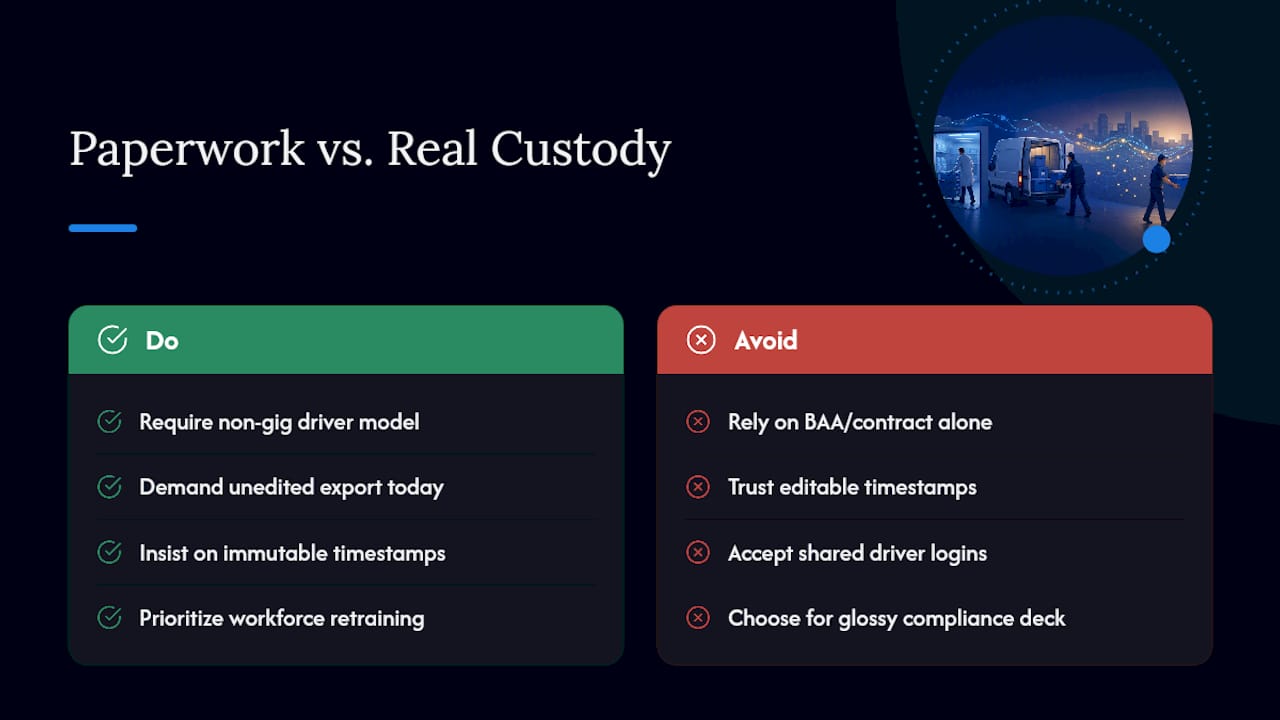
The invisible middle. Pharmacy records who handed it out. The driver records the delivery. Nobody records the transfer between them, or the hours the package sat in a vehicle. That gap is where an audit stops and asks questions.
Left at door. Perfectly reasonable for a routine refill, and fatal for a controlled substance. If your courier's default is to leave when nobody answers, that default has to be overridden per delivery type, not per driver's judgement.
Batch signatures. A single signature covering fifteen packages at a facility is one record, not fifteen. If one goes missing you cannot show it arrived.
Subcontracting. If your courier can hand your work to another company without telling you, your custody chain includes a party you never assessed. That is a contract question, and worth answering before you sign rather than after an incident.
Records you cannot reach. Proof that exists only inside the courier's system, produced on request by email, is not usable in an audit timeframe.
Questions to ask before you sign
- What security do you provide against in transit loss, specifically, and can you put it in writing? (You need this for your DEA file.)
- Is the outer packaging unmarked as to contents?
- Can delivery rules be set per medication type, so controlled substances require a named signature and routine refills do not?
- Do you subcontract, and will you tell us when you do?
- Can we pull a full custody record ourselves, without contacting you?
- How long are records kept, and can we export them?
- Who are the named drivers on our route, and are they background checked?
- Do you sign a Business Associate Agreement where one applies under HIPAA?
A courier that answers all eight in writing is one you can put in a compliance file. One that answers verbally is one you will be reconstructing later.
How AMCO handles pharmacy work
Our pharmaceutical delivery runs on named handoffs. Release and receipt are timestamped at both ends, each handoff is captured with a signature or photo taken at the door, and the record sits in your portal so your team can pull it directly rather than requesting it from us.
Delivery rules are set per client and per medication type, so a prescription that must not be left unattended is not subject to a driver's judgement on the day. Recurring pharmacy routes run as a dedicated route with an assigned driver and a trained backup, which also means the same small group of people handles your deliveries rather than whoever is free. Broader clinical work is covered under our medical courier service, and the vetting checklist for that sits in our guide to medical courier requirements in Washington.
If you are building a vendor file, ask us the eight questions above and we will answer them in writing.
Building a custody-documented delivery programme?
Tell us your delivery types and what each one requires. We will set the rules per type and show you the record before you commit.
Frequently asked questions
What is chain of custody in pharmacy delivery?
A documented, unbroken record of everyone who held a medication between the pharmacy and the patient, with each transfer named and timestamped. It is what lets you prove where a package was at any point, rather than only that it eventually arrived.
Can a courier deliver controlled substances?
Pharmacies do use carriers for controlled substances, but under 21 CFR 1301.74(e) the registrant is responsible for selecting carriers that provide adequate security against in transit losses. The choice of courier is part of your compliance position, so assess it deliberately and keep a record of that assessment.
Does the packaging need to be unmarked?
Yes for controlled substances. The same regulation lists precautions including assuring that shipping containers do not indicate that the contents are controlled substances.
Is proof of delivery the same as chain of custody?
No. Proof of delivery records the final handoff. Chain of custody records every handoff, including the transfer from pharmacy staff to driver, which is the link most often missing.
Can medications be left at the door?
For routine refills that is often acceptable. For controlled substances, high value specialty medication or anything under a REMS programme, it should be blocked by a rule set per medication type rather than left to the driver on the day.
How long should custody records be kept?
Long enough to satisfy your state board, your DEA obligations and any REMS programme you participate in, whichever is longest. Confirm your courier's retention period in writing, and check you can export records rather than only view them.
Sources
- 21 CFR 1301.74, other security controls for non-practitioners, Legal Information Institute, Cornell Law School.
- Business Associates guidance, US Department of Health and Human Services.
- Risk Evaluation and Mitigation Strategies (REMS), US Food and Drug Administration.
Related articles

How to Organize an Outpatient Lab Courier Schedule
Build it backwards from your lab's cutoff and your specimens' stability windows. Six steps for clinic managers, including what to put in the
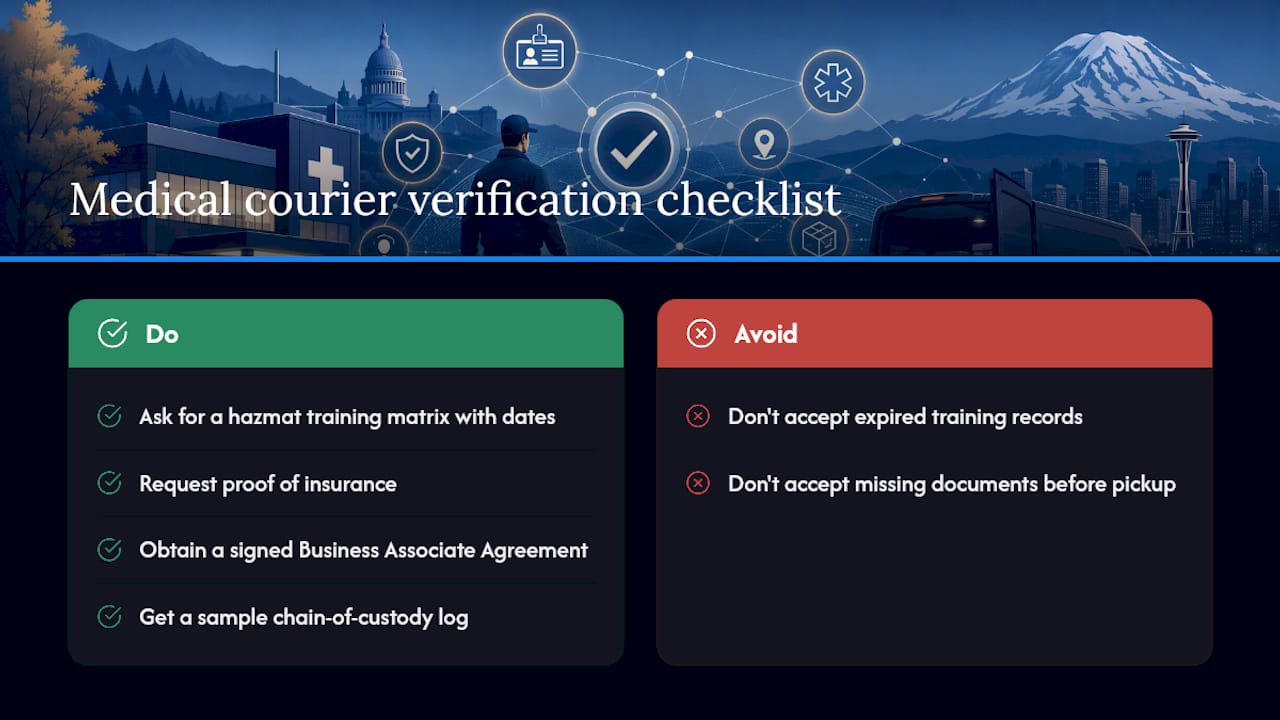
Medical Courier Requirements in Washington: Full Checklist
What the specimen requires and what the courier must produce, in one place: UN3373 packaging measurements, OSHA training and Exposure Contro
STAT vs Routine Lab Courier: What Healthcare Teams Should Know
STAT goes direct and alone, routine rides a scheduled route. The real question is whether the result changes treatment in the next hour, and