Medical Courier Requirements in Washington: Full Checklist
Jump to section
Two things have to be right before a Washington clinic hands a specimen to a courier: the packaging, which is a federal specification with exact measurements, and the courier itself, which is a documentation question. This covers both. Ask for the documents rather than the assurances, and package to the classification rather than to habit.
Part one: what the specimen requires
Classification decides everything else
| Class | What it means | UN number |
|---|---|---|
| Category A | Capable of causing permanent disability or life threatening disease in otherwise healthy people when exposure occurs | UN2814, UN2900 or UN3549 |
| Category B | Infectious substances not meeting the Category A test. Most routine diagnostic specimens | UN3373, "Biological substance, Category B" |
| Exempt | Routine testing unrelated to diagnosing infectious disease, such as drug screens, cholesterol or pregnancy tests, where there is a low probability the sample is infectious | None required |
Two useful details sit in that table. Exempt samples need no hazardous materials marking at all, so a clinic packaging everything as UN3373 is doing work it does not have to. And the regulation contains a further exception for samples carried by private carriers in vehicles used exclusively to transport such materials, which describes a dedicated medical courier operation.
The UN3373 packaging specification
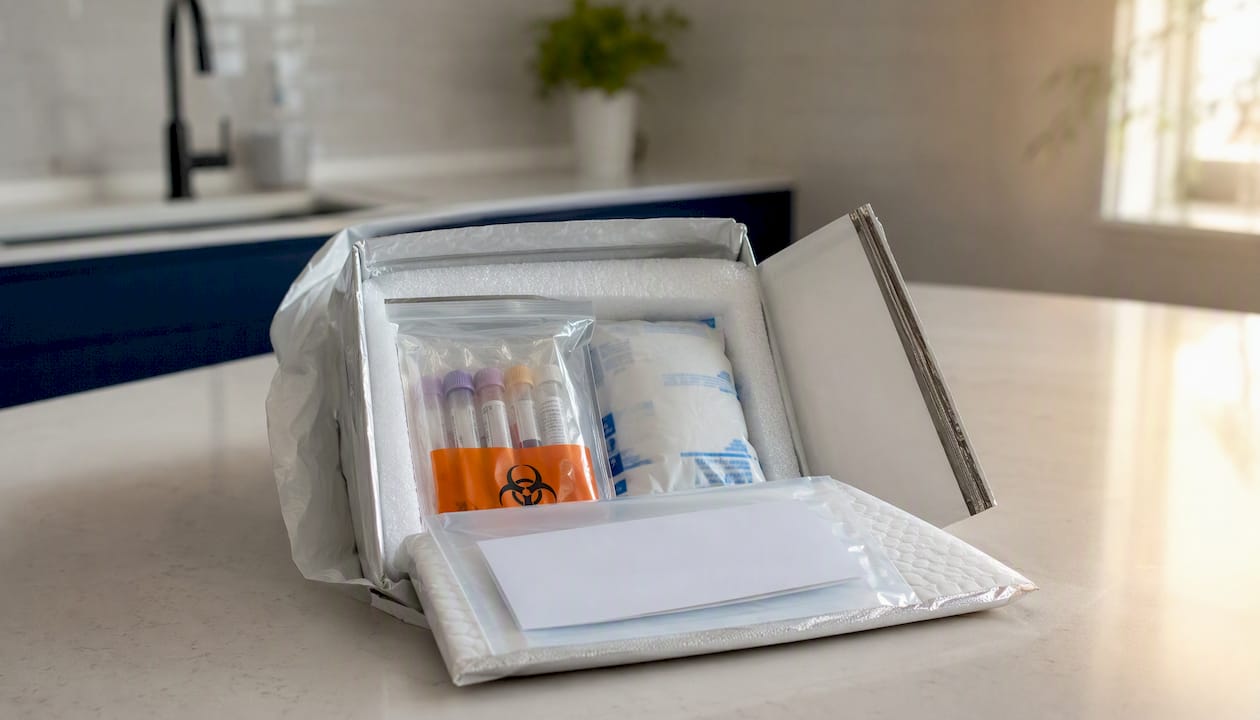
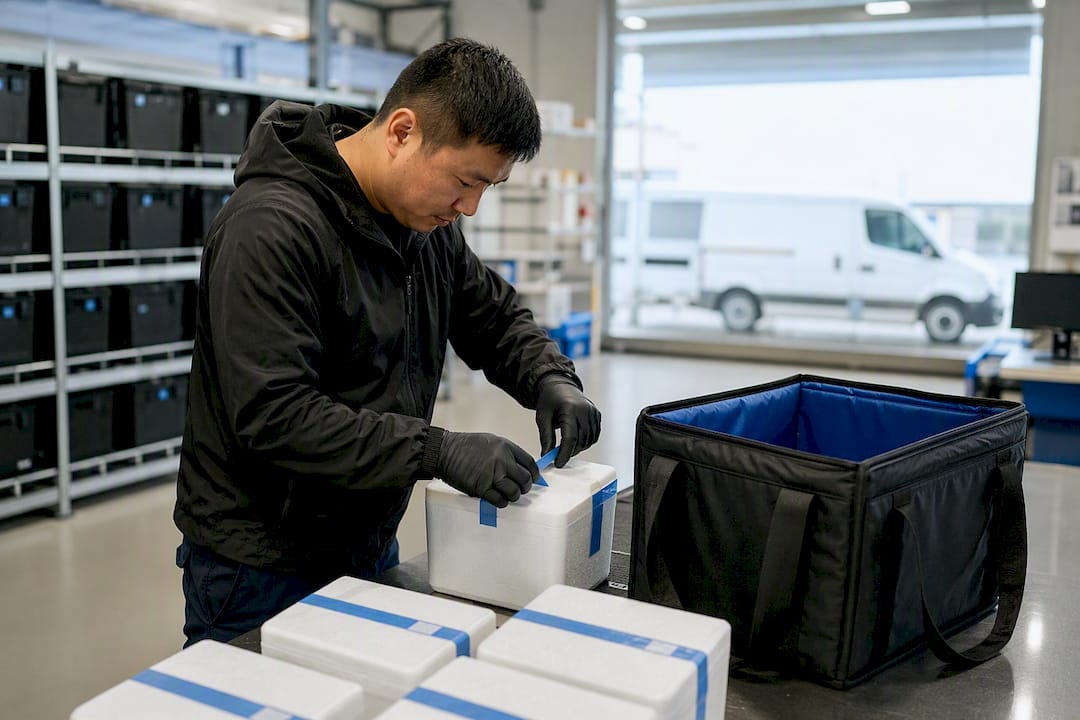
Set out in 49 CFR 173.199, and more precise than most summaries admit. Three layers: a primary receptacle, secondary packaging positioned so the primary receptacles "cannot break, be punctured, or leak their contents" under normal transport conditions, and a rigid outer packaging.
For liquids, absorbent material goes between the primary and secondary layers, in a quantity "sufficient to absorb the entire contents of the primary receptacles". All of it, not some of it. This is the requirement most often under met, and it is what turns a contained leak into an incident.
Then the measurements almost nobody quotes:
- The package must pass a drop test from 1.2 metres, about 3.9 feet.
- At least one outer surface must measure at least 100 mm by 100 mm.
- The UN3373 diamond must have no side shorter than 50 mm.
- "Biological substances, Category B" must appear beside it in letters at least 6 mm high.
Why letter height matters. These are the details a carrier refuses a package over, and the first things an inspector checks, because they can be measured from across a room. A package can be entirely safe and still non compliant because the marking is too small.
Who supplies the packaging
Settle this before the first pickup. Some couriers provide compliant kits, others expect the facility to package everything and simply carry what they are handed. Neither is wrong, but responsibility for a leak follows the packaging, so it should be written down rather than assumed.
Part two: what the courier must be able to produce
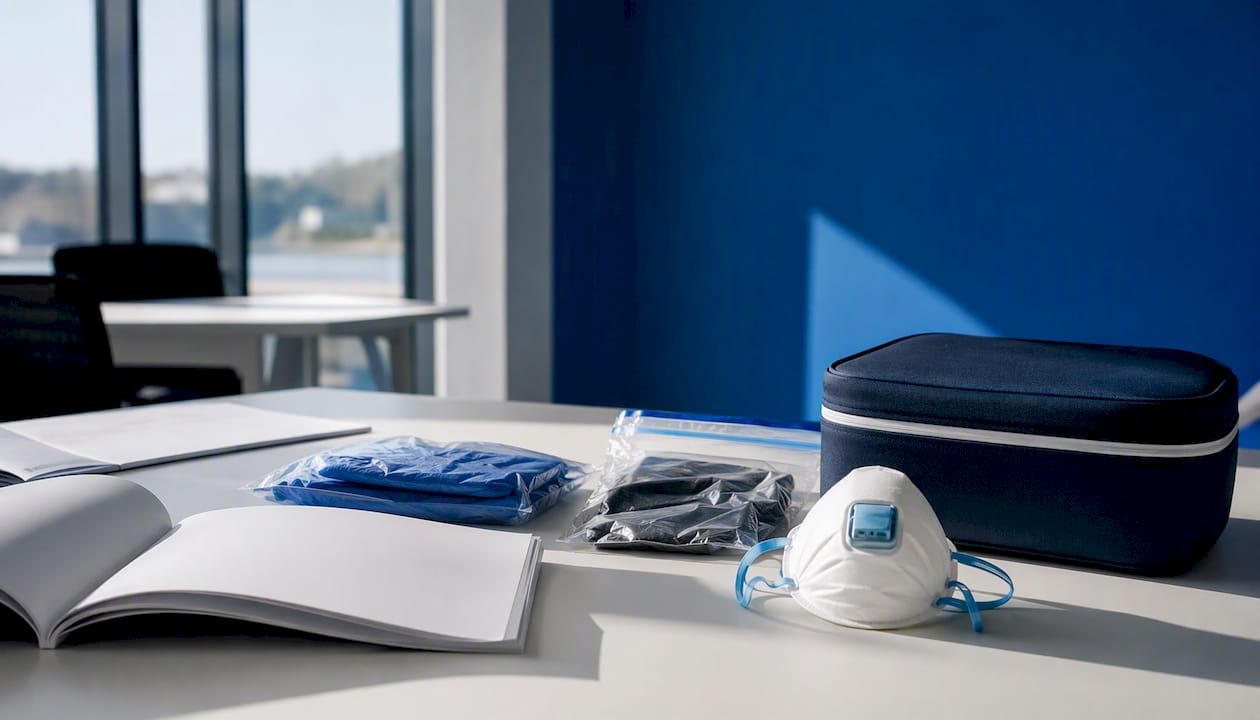
A written OSHA Exposure Control Plan
The Bloodborne Pathogens standard, 29 CFR 1910.1030, requires employers with occupationally exposed staff to keep a written Exposure Control Plan. The regulation is specific about upkeep: it "shall be reviewed and updated at least annually and whenever necessary to reflect new or modified tasks and procedures which affect occupational exposure".
So there are two questions, not one. Does the plan exist, and when was it last reviewed? A plan written years ago and never revisited does not meet the standard.
Training records with dates on them
Under the same standard, training must be provided "at the time of initial assignment to tasks where occupational exposure may take place" and "at least annually thereafter".
Annually is the part that slips. Ask for a record showing each driver on your route, the date of their last session, and when the next is due. Training once at onboarding and never again is out of compliance regardless of how careful the driver is.
The HIPAA question, and what most articles get wrong
You will read that no medical courier can touch a specimen without a signed Business Associate Agreement. That is not what the rule says, and the difference makes you a better buyer.
HHS guidance describes a conduit exception. The Privacy Rule does not require business associate contracts with organizations that "act merely as conduits" for protected health information, and it names private couriers as an example alongside the postal service. The exception is narrow: access to PHI must be transient, and an entity accessing PHI on a regular or frequent basis to perform a service is not a conduit.
- Transport only, sealed container, no handling of records, is the case the exception was written for.
- Anything more, such as holding requisitions, entering results, storing specimens, or accessing your systems, makes the courier a business associate and a BAA is required.
Many Washington facilities require a BAA regardless as a matter of policy, which is entirely reasonable. Ask your compliance officer which situation matches your workflow rather than accepting a blanket claim either way.
Insurance and driver credentials
Ask for a certificate of insurance rather than a figure quoted over the phone: commercial auto, general liability and cargo coverage, with the limits written down. Confirm drivers are background checked and that the courier can tell you who is on your route. For recurring clinical work, also ask what happens when your regular driver is sick, because a courier with trained backups keeps your route running and one without simply misses the pickup.
Chain of custody you can produce later
The requirement that matters after the fact is documentation. For each leg you want:
- Who released the specimen and at what time.
- Who received it and at what time.
- A signature or photograph captured at the handoff, not typed in afterwards.
- An identifier tying the record to that specific specimen or container.
- Any exception, with its reason.
The test is whether you can answer "who had this at 11am on the fourteenth" in under a minute, three weeks later, without phoning anyone.
Washington specific submission rules
If you submit to the Washington State Public Health Laboratories, their submission and shipping requirements sit on top of everything above: accepted specimen types, correct forms, delivery timing. Confirm your courier has read them rather than assuming general medical transport covers it. The Washington State Department of Health publishes the current requirements, and APHL maintains the packing and shipping guidance the labs work from.
Part three: what actually goes wrong
Collection problems like a wrong tube happen before a courier arrives. The failures that belong to transport are narrower, and all of them are preventable.
Time. The most common by far. Every test has a stability window published by your lab, and the clock starts at collection, not at pickup. A specimen waiting for an afternoon run has already spent much of its window before anyone drives anywhere.
Handling conditions. Your lab specifies how each specimen type should be held in transit. That belongs in the courier's hands in writing, per specimen type.
Packaging failure. Usually the absorbent layer, skipped or insufficient for the volume.
Paperwork. A specimen arriving without its requisition cannot be processed. It travels with the sample or it fails.
Custody gaps. Not a rejection cause, but the one that hurts later. Without a record of who handed it over and when, a missing specimen becomes unanswerable rather than traceable.
The request to send a courier you are evaluating
Copy this into an email. A courier set up for clinical work answers it inside a day.
- Your written Exposure Control Plan, and the date it was last reviewed.
- Bloodborne pathogens training records for the drivers who would run our route, with dates.
- A certificate of insurance showing auto, general liability and cargo limits.
- Who supplies UN3373 packaging for Category B shipments, you or us.
- A sample chain of custody record from a completed delivery.
- Your position on a Business Associate Agreement, and a copy if you have a standard one.
- What happens to our route when the assigned driver is unavailable.
What to hand the courier on the day
- Specimens packaged and marked to their classification, with requisitions travelling with them.
- Written handling instructions per specimen type, taken from your lab's requirements.
- Your lab's cutoff, and the stability window that matters most in today's batch.
- A named contact at both ends with a phone number that gets answered.
- Collection times, so the driver knows which clock is already running.
How AMCO handles clinical work in Washington
We run medical courier routes across the Seattle metro and Washington for labs, clinics and pharmacies. Drivers are HIPAA and OSHA trained for medical transport, every pickup and delivery is timestamped, and each handoff is captured with a signature or photo that stays in your portal rather than in a folder somewhere.
Recurring clinical pickups run as a dedicated route with an assigned driver and a trained backup, which is what makes a daily lab run predictable. Pharmacy work is handled the same way through our pharmaceutical delivery service. Choosing between an urgent run and a scheduled one is covered in our guide to STAT versus routine lab transport.
If you are working through the checklist above, send it to us. We would rather answer it in writing than ask you to take our word for it.
Vetting a medical courier in Washington?
Send the checklist, or tell us your route and collection times and we will price it as a scheduled run.
Frequently asked questions
What are the medical courier requirements in Washington State?
There is no single medical courier licence. Compliance comes from several places at once: UN3373 packaging for Category B specimens under 49 CFR 173.199, the OSHA Bloodborne Pathogens standard for training and an Exposure Control Plan, HIPAA where the courier does more than transport, commercial insurance, and the submission rules of whichever lab you send to.
What is UN3373?
The classification for Biological substance, Category B, covering most routine diagnostic specimens. It requires triple packaging plus specific marking: a diamond with no side shorter than 50 mm and the proper shipping name in letters at least 6 mm high.
What is the difference between Category A and Category B?
Category A substances can cause permanent disability or life threatening disease in otherwise healthy people on exposure, and ship under UN2814, UN2900 or UN3549. Category B covers infectious substances that do not meet that test, which is the overwhelming majority of clinical specimens.
Do all specimens need hazardous materials packaging?
No. Samples for routine testing unrelated to diagnosing infectious disease, where there is a low probability the sample is infectious, are excepted. Drug screens, cholesterol panels and pregnancy tests are the examples the regulation gives.
Does a medical courier need a HIPAA Business Associate Agreement?
Not always. HHS guidance says entities acting merely as conduits for protected health information, which includes certain private couriers, do not require one, provided access to PHI is transient. A courier that handles records, stores specimens or touches your systems is not a conduit and does need a BAA.
How often does a courier need bloodborne pathogens training?
29 CFR 1910.1030 requires training at initial assignment to tasks with occupational exposure, and at least annually after that. Ask for dated records rather than a general statement that drivers are trained.
How much absorbent material is required in the packaging?
Enough to absorb the entire contents of the primary receptacles, placed between the primary and secondary packaging. It is the requirement most often under met.
What insurance should a medical courier carry?
Commercial auto, general liability and cargo coverage at minimum. Ask for a certificate of insurance with the limits stated rather than a verbal figure, and check it is current.
What is the most common compliance gap?
Expired annual training. Initial onboarding usually happens. The yearly refresh is the one that quietly lapses, and it is the first thing an auditor asks for.
Sources
- 49 CFR 173.199, Category B infectious substances, Legal Information Institute, Cornell Law School.
- 49 CFR 173.134, Division 6.2 definitions and exceptions, Legal Information Institute, Cornell Law School.
- 29 CFR 1910.1030, Bloodborne Pathogens, US Occupational Safety and Health Administration.
- Business Associates guidance, US Department of Health and Human Services.
- Washington State Department of Health.
- Association of Public Health Laboratories, packing and shipping guidance.
Related articles
Pharmacy Delivery Chain of Custody: A Practical Playbook
Under DEA rules, choosing your courier is part of your compliance position, not just procurement. What a custody record must contain, where

How to Organize an Outpatient Lab Courier Schedule
Build it backwards from your lab's cutoff and your specimens' stability windows. Six steps for clinic managers, including what to put in the
STAT vs Routine Lab Courier: What Healthcare Teams Should Know
STAT goes direct and alone, routine rides a scheduled route. The real question is whether the result changes treatment in the next hour, and